
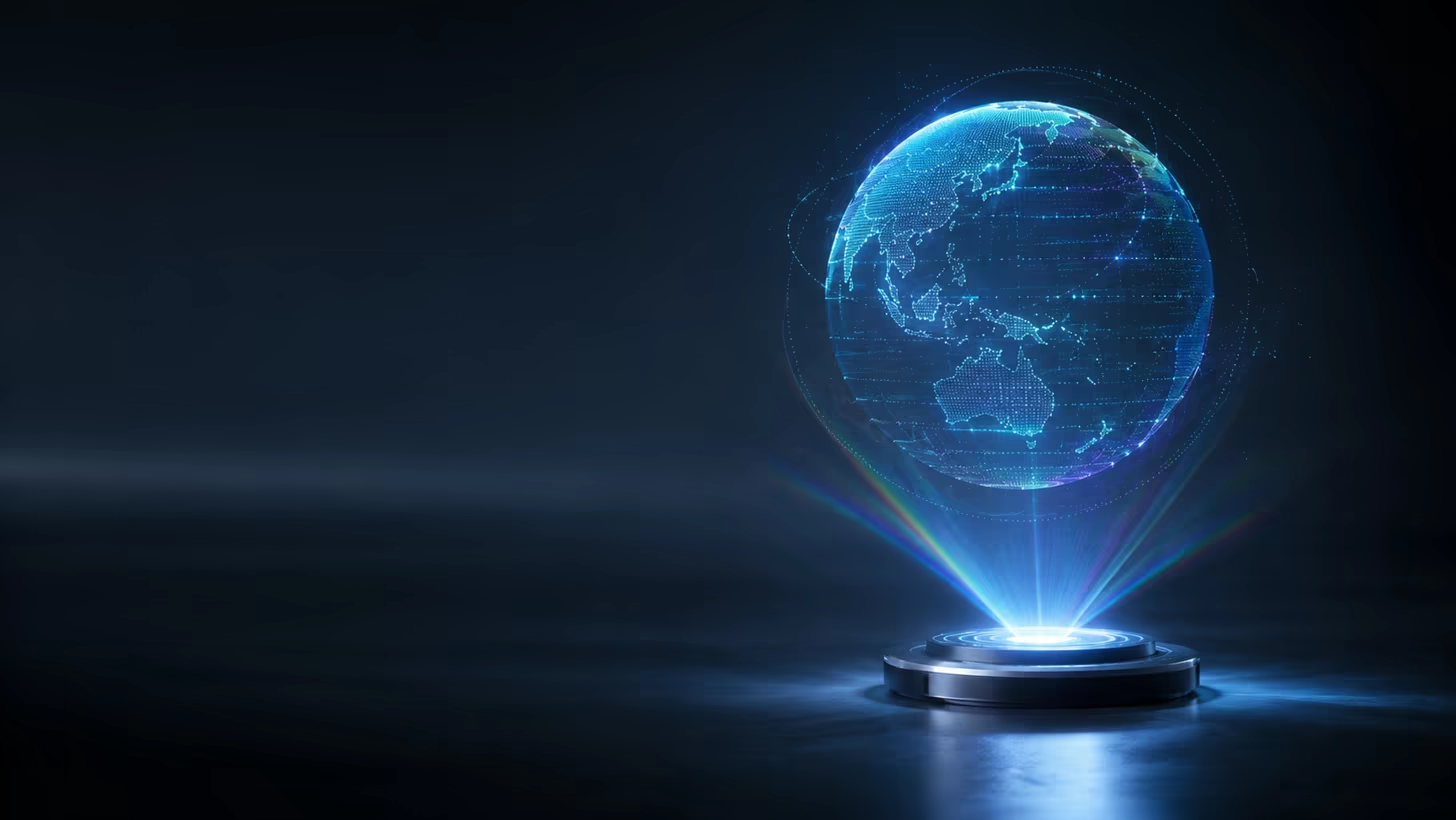
A hologram is a technology that records and reconstructs a true three-dimensional image of an object using the interference and diffraction of light — and the word also refers to the recorded medium itself. From the anti-counterfeiting security seals on banknotes and credit cards, to floating images in science-fiction movies, to modern concert staging and digital signage, the word "hologram" shows up everywhere. This article explains what a hologram is, how holography works, the main types, real-world uses in banknotes and security, and the difference from "hologram-like" video tricks.
What is a Hologram? Meaning and Definition
The word "hologram" comes from the Greek holos (whole) and gramma (something written / a record), meaning "a recording of the whole." Unlike an ordinary photograph, which captures only the brightness and color of light, a hologram also records the phase of the light wave — the information that lets our eyes perceive depth. As a result, a true hologram reproduces parallax: the image changes as you move your head, so you can effectively "look around" the recorded object, just like a real 3D scene. By contrast, the science-fiction idea of "projecting light into empty space so that an image floats in mid-air" is not a hologram in the strict scientific sense.
How Holography Works: Interference and Diffraction of Light
A classic optical hologram is created by splitting a single laser beam into two paths. One beam (the object beam) is reflected off the subject; the other (the reference beam) goes straight to a high-resolution photosensitive plate. Where the two beams meet, they create an interference pattern that is recorded on the plate. When the plate is later lit with a similar light source, that fine pattern diffracts the light and reconstructs the original wavefront — and your eyes see a 3D image floating in space. In short: a hologram records light waves themselves, not just a flat picture.
Hologram vs Holography: What's the Difference?
People often mix up "hologram" and "holography." Holography is the method — the overall technique of recording and reconstructing 3D images with light. A hologram is the result — the actual recorded plate, film, or image produced by holography.
Types of Holograms
Embossed Holograms (the kind on banknotes and cards)
An embossed hologram records the interference fringes as a fine surface relief (microscopic bumps) on a film. Technically, it starts from a rainbow (transmission) hologram master, whose relief is stamped (embossed) into a plastic film to mass-produce copies. An aluminum reflective layer is then applied to the back so it can be viewed in reflected — rather than transmitted — light, shifting through rainbow colors with a sense of depth as you tilt it. Because they are bright and cheap to mass-produce, embossed holograms are the seals you see on banknotes, credit cards, passports, and brand packaging for anti-counterfeiting.
More recently, instead of recording a real object with a laser, it has become possible to create full-color embossed holograms from 3DCG models of objects that don't physically exist, using techniques such as electron-beam (EB) drawing, reproducing rich color along with smooth motion and depth.
Lippmann Holograms (reflection type, high security)
A Lippmann hologram records the interference fringes of light reflected from an object as density variations inside a special photopolymer layer on the film. Whereas embossed holograms mainly show left-right depth, Lippmann holograms reproduce outstanding depth in all directions, and because they require advanced duplication technology, only a limited number of manufacturers worldwide can mass-produce them. They are used for high-security anti-counterfeiting and brand protection.
Digital Holograms (CGH)
A digital hologram — a Computer-Generated Hologram (CGH) — is a hologram whose interference fringes are calculated by a computer. In particular, a full-parallax, high-definition CGH can reconstruct a deep, three-dimensional image that looks "as if the object were really there," and it is being researched as the foundation of next-generation holographic displays.
An example of a digital hologram (CGH): a full-parallax, high-definition computer-generated hologram (FPHD-CGH). Image via Kansai University, WaveField Tools "CGH Gallery".
Real-World Uses: Banknotes, Credit Cards, and Security
The most familiar hologram in daily life is the one used for security. Banknotes around the world — including the latest Japanese notes with their 3D rotating portrait hologram — use holograms because they are extremely difficult to copy. Credit cards, passports, brand-name goods, software packages, and concert tickets all use holographic seals for anti-counterfeiting and brand protection — and, on software and content products, as a measure against piracy and copyright infringement. Because the interference pattern cannot be reproduced with a normal printer or copier, a hologram acts as a trustworthy "proof of authenticity."
"Hologram-like" Video Tricks and Common Misunderstandings
Many things marketed as "holograms" are not holograms in the strict optical sense. Floating characters at a concert, the spinning 3D hologram LED fan in a shop window, transparent-screen signage, and "Pepper's Ghost" stage illusions all create a hologram-like impression, but they are really 2D images shown with clever optics, reflection, or persistence of vision — there is no recorded interference pattern and usually no real parallax.
How Portalgraph Delivers a Hologram-like 3D Experience
Portalgraph is a VR projection technology that turns ordinary projectors, TVs, LED displays, and monitors into a window onto a virtual world. It does not record light on film like a true hologram, but it achieves a hologram-like experience — a 3D object appearing to float in real space — by rendering stereoscopic images in real time based on the viewer's head position. Users wear only lightweight stereoscopic glasses — not a bulky headset — so they can still see the real world, and several people can share the same 3D experience at once.
If a true optical hologram is "light recorded on a plate," you can think of Portalgraph as a pseudo-hologram experience computed in real time on the displays you already own — easy to deploy at events, museums, classrooms, and showrooms.
Portalgraph — a hologram-like 3D experience using everyday displays.
Conclusion
A hologram records the whole of light — its phase as well as its brightness — to reconstruct a genuinely three-dimensional image, and it underpins everyday security on banknotes and cards as well as cutting-edge displays. Many "holograms" you see in marketing are actually hologram-like video tricks that differ from a hologram in the strict scientific sense. In this article, we covered what a hologram is, how it works, its main types, the difference between a hologram and holography, its use in banknotes and security, and how it differs from "hologram-like" video tricks.